Ways of Knowing Water Library
 As we close down this exhibition, I thought it would be nice to keep our little library collection together, at least in electronic space. So below you will find a little annotated bibliography I threw together. (And thank you Sarah Gibbons, Student Assistant)
--Eva Ball, Exhibitions Preparator
The River Reader: A Nature Conservancy Book, edited by John A Murray (1998)
From School Library Journal:
"Readers ride the rivers of three continents with some of the most gifted writers of modern times in this thoughtfully chosen collection. In the introduction, Murray places the authors in their regional and historical context. What follows is a riveting armchair journey. After all, what would a collection of river writings be without that great raconteur Mark Twain sharing his prodigious knowledge of river piloting in the selection from Life on the Mississippi. Or John Wesley Powell's white-knuckle narrative of his harrowing descent through the Grand Canyon of the Colorado. Even modest little creeks can briefly become mighty torrents as described in the laconic humor of Annie Dillard. Louise Wegenknecht reminds readers that "Rivers are more than hydrology; they have lives and souls and can be hurt." She grew up on soil drained by the mighty Klamath River and its tributaries, which have been so adversely effected by the logging industry in northern California and Oregon. And rivers can be malignant, as Joseph Conrad observes. Finally there are excerpts from Eddy Harris's Mississippi Solo, which chronicles an adventure he was not altogether prepared for. For nature lovers, this collection is the next best thing to being on the river itself. Any river."
The Greenpeace Book Of Water, by Klaus Lanz (1995)
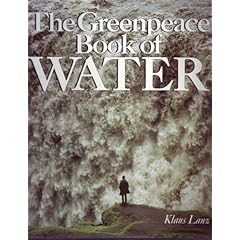
From The Latham Letter:
"...illustrative text, in-depth case studies, and spectacular photos are alternately moving in their beauty and frightening in their reality....Revel in the lush look of mist clinging to the trees in the Costa Rican rain forest, the beauty of water lilies gracing the surface of a lake in Wales, or the languid dip of a wooden oar in the reflected rays of a setting sun in China's River Li....Witness through word and picture the damage being caused by pollution, contamination, acid rain, inefficient sewage systems, phosphates from detergents and cleansers, and the simple overindulgence of people who believe their water supply is infinite. Many interesting, historic uses of water for cleansing purposes, rituals, transportation, energy and irrigation are detailed together with the various effects of each use on the world's water supply....Filled with fascinating and beautifully portrayed information."
Riverwalking: Reflections On Moving Water, by Kathleen Dean Moore (1996)
From the back cover:
"Kathleen Dean Moore is a stunning new voice among the literary naturalists. Her writing, like that of Annie Dillard or Edward Hoagland, shows us a vast, complex, partly hidden and startling world that has always been right before our eyes. In these twenty elegant and provocative essays, she invites us to travel through the West with her, and often with her family, as she rafts down rapids, hikes through dunes, camps in the desert, and walks along riverbanks. All along the way, she shares her remarkable observations about the life - both human and otherwise - that is sustained by rivers. Moore ponders love, loss, motherhood, happiness, evolution, and country music with ease and acuity.Moore is a philosopher by training and a naturalist by sentiment. The way in which she sees the world and way in which she gracefully imparts how she sees it, is a mixture of both disciplines: part keen analysis, part sumptuous embrace, of all that she sees, hears, and feels in the moving water of rivers and of memory.The result is Riverwalking, a collection that is enlightening, moving, and brilliantly conceived."
Water Music, by Majorie Ryerson (2003)
From the publisher:
"A photography book with a social conscience, Water Music affirms the intimate connection of water to the rhythms of our lives-and how it is something to be celebrated, revered, and preserved for today and for future generations. Water Music is first a tribute to the inspiration and magic of water. For photographer Marjorie Ryerson, a fascination with water grew from the challenge of capturing on film the astonishing breadth of ways in which water presents itself-the way, for instance, that Lake Superior at sunset turns from deep blue to gold, copper, blazing red, dusty pink, pewter, and, finally, shimmering black. To accompany the dazzling photographs, Ryerson recruited some of the most important names in music. These world-class artists, from twenty-two countries on five continents, and from across the musical spectrum, have contributed memoirs, stories, poetry, music, and lyrics for Water Music, reinforcing the beauty of the images and the powerful message they convey. For rhythmist Mickey Hart, the feel and sound of rain resulted in a kind of epiphany for him that has influenced his music ever since. Flutist Mary Youngblood explains that her life as a musician has been inextricably linked with having been born under the water sign of Cancer. Violinist Pamela Frank explores the many similarities between water and music, finding both essential for survival. Together, Ryerson's photos and the words and music of these renowned musicians remind us why we must heed the message in Paul Winter's introduction-in spite of our reverence and awe, we have placed this most essential element in peril. And so, we too are called upon to remind ourselves of the preciousness of water, before the damage becomes too severe to be undone. Water Music has thus become a piece of a much larger picture: the Water Music Project. Ryerson began the larger project not only to celebrate the beauty of water and its connection to music and to our lives, but also to increase awareness about water issues through concerts, lectures, events, and educational outreach. She is donating her net royalties from sales of the book to the Water Music Fund, established at her request at the United Nations Foundation. The UNF will use the fund to aid water in the natural environment and to provide clean drinking water for families around the world."
Who Owns The Water?, edited by Klaus Lanz, Lars Muller, Christian Rentsch and Rene Schwarszenbach (2006)
From the publisher:
"The shortage of fresh, clean water,” states a report by the Human Rights Commission, "is the greatest danger to which mankind has ever been exposed.” It is only thanks to water and its mysterious qualities that life on earth is possible at all. Without water there would be no food, no clothing, there would not even be the ink the Bill of Rights was written with.Who owns the Water? discusses the phenomenon of water, marvels at its uniqueness and addresses the dangers and opportunities water offers to life. The book looks at the most important questions about providing drinking water and producing food, but also deals with water as a destructive force, and investigates the chemical qualities of the molecule. Who owns the Water? points out the risks of unlimited privatization of water, and records how dependence on water is exploited. Committed picture sequences and detailed texts explain how water can belong to no one, but has to be treated responsibly and held in appropriate esteem by the whole of mankind."
The Secret Life of Water, by Masaru Emoto (2005)
From Midwest Book Review:
"A blend of science and spirituality marks Masaru Emoto's lovely The Secret Life Of Water, which links the search for happiness and serenity with the life of water on this planet. From interviews with healers and shamans whose powers have changed the shape of water itself to photos of water crystals and cycles of water and life, it's hard to easily peg The Secret Life Of Water -- but it will often find its way onto the science shelf and from there into the welcoming hands of spiritual readers as well."
Streamkeepers Field Guide: Watershed Inventory and Stream Monitoring Methods, by Tom Murdoch, Martha Cheo and Kate O’Laghlin
(no information available)
Watershed Dynamics, by William Carlsen and Nancy Trautman (2004)
**Full student edition on Google Books.
From the publisher:
"Whether you’re a stream studies novice or a veteran aquatic monitor, Watershed Dynamics gives you abundant practical resources to extend your students’ investigations into local water quality and land-use issues. This two-part set is ideal for teaching biological and ecological concepts and research techniques. It also shows how the interplay between scientific data and human judgment can shape public policy decisions on zoning, flood control, and agricultural practices."
Freshwater, by E.C. Pielou (2000)
From Library Journal:
"Our planet is composed primarily of water, much of which is the ocean and not the subject of this book. Naturalist Pielou (A Naturalist's Guide to the Arctic, LJ 11/1/94) concentrates on fresh water (usable by humans), which is a much smaller resource. Pielou describes the natural history of fresh water?where it comes from, where it goes, and how it moves under and over the earth and into the atmosphere. Even though scientists now believe that water is being added to our environment by "snowball" comets entering our atmosphere, the world's supply of fresh water is dwindling?and a shortage of usable fresh water ultimately limits population growth. Pielou's book would make an excellent textbook for any college class studying water. However, while the text is highly informative, it will not appeal to the average reader because of its technical nature. "
Topographical Description of the Western Territory of North America, by Gilbert Imlay (1797)
Illustrated with correct Maps of the Western Territory of North America; of the State of Kentucky, as divided into Counties, from actual Surveys by Elihu Barker; a Map of the Tenasee Government; and a Plan of the Rapids of the Ohio. The Third Edition With Great Additions. London: Printed For J. Debrett, Opposite Burlington House, Piccadilly.
Ohio Water Firsts, by Sherman L. Frost and Wayne S. Nicholis
(no information available)
Water Follies: Groundwater Pumping And The Fate Of America's Fresh Waters, by Robert Glennon (2004)
From Scientific America:
"In the high plains of Texas the farmers who grow cotton, alfalfa and other crops are entitled by law to as much underground water as they can reasonably use. No matter that this water comes from the Ogallala Aquifer, that vast underground reservoir whose levels have dropped precipitously since 1940. No matter that the overpumping threatens eventually to put thousands of farmers across seven states out of business. The illusion, codified in the law not just in Texas but in much of the U.S., is that groundwater is somehow boundless, or in a category apart from lakes, rivers and streams, and ought not be regulated, even for the common good. Now comes Robert Glennon to puncture this illusion, in a book as rich in detail as it is devastating in its argument. Its focus on groundwater brings overdue attention to a category that accounts for nearly a quarter of American freshwater use. Its title, Water Follies, sets the tone for tales that can be tragicomic; this is a book about water being squandered, so it is also, as the author puts it, a book about "human foibles, including greed, stubbornness, and especially, the unlimited human capacity to ignore reality." Take, for example, his story of the fast-food french fry. It used to be that potatoes were grown on unirrigated land, he writes, but Americans' love of processed foods changed that. Uneven moisture leads to small, knobby, misshapen potatoes, so most American growers, even in places such as Minnesota, routinely irrigate their lands, to produce products acceptable to the industry and customers like McDonald's. But in Minnesota the groundwater that farmers pump for potatoes turned out to be the same water that helps to sustain the Straight River, a major trout fishery. Even modest pumping for potatoes, a federal study eventually concluded, had the potential to reduce the river's flow by one third during irrigation season, with adverse impact on the brown trout. For now, the trout are not in danger, but that could change if Minnesota were to approve applications from farmers still eager to see potato planting and irrigation widen. "One long-term answer, of course," Glennon notes, with characteristic wryness, "is for us, as American consumers, to accept french fries that have slightly different colors, or minor discolorations, or even ones that are not long enough to stick out from a super-size carton." Farmers are not the only ones who get a hard time for their shortsightedness. Bottled-water purveyors, particularly Perrier, are tarred for their pursuit, in places such as Wisconsin, of cool, underground (and highly profitable) springwater in quantities so vast as to prove devastating to the ecology of nearby rivers. The gold-mining industry is called to account for "dewatering" operations in, for example, Nevada, where it makes way for its deep operations by pumping away groundwater at a stunning rate. And planners in Tampa, Fla., and San Antonio, Tex., come under fire for their cavalier reliance on perishable underground sources such as Texas's Edwards Aquifer to fuel development they are finding difficult to sustain. The cumulative picture painted by the author is a grim one. Already four states-- Florida, Nebraska, Kansas and Mississippi-- use more groundwater than surface water, and more and more are looking underground to support growing populations. Becoming equally apparent are the consequences in dry rivers, land subsidence, and aquifers drawn down far faster than they can ever be recharged. "The country cannot sustain even the current levels of groundwater use," Glennon writes, "never mind the projected increases in groundwater consumption over the next two decades." Why is it that groundwater has become subject to such abuse? One reason, of course, is that buried below the surface, it is hidden from the kind of relentless monitoring that in recent decades has helped clean up rivers such as the Erie and the Hudson. But Glennon, a professor of law at the University of Arizona, finds buried in the law some further reasons for the neglect. Even now, he says, most American laws affecting groundwater do not recognize any connection between underground and surface waters, despite abundant evidence of such links. They remain rooted in 19th-century ideas that underground flows were something so mysterious that they could not be understood, an assumption that has been translated into lax or nonexistent regulation. In most parts of the U.S., the author points out, surface water is subject to doctrines of riparian law or prior appropriation, with water rights carefully parceled out to various claimants. Groundwater, in contrast, is most often subject to the rule of capture, which, as Glennon observes, essentially means that "the biggest pump wins," notwithstanding the impact on surface water or the aquifer itself. To Glennon, the plight of the country's groundwater has come increasingly to represent what biologist Garrett Hardin called "the tragedy of the commons," a direct result of allowing citizens unlimited use of a common area. Among his recommendations for the future is an immediate halt to unregulated groundwater pumping. To some ears, especially those of high-plains Texas farmers, that is certain to sound like an unconscionable assault on property rights. But Water Follies makes the case that groundwater is something that we all should regard as very public indeed."
Discovering Unknown Landscape: A History Of America's Wetlands, by Anne Vileisis (1997)
From Publishers Weekly:
"Whether seen as "bugs and mud" or as breeding grounds for countless species of fish, birds and other organisms, wetlands have borne much of the brunt of our development as a nation, argues environmental historian and naturalist Vileisis. Here, her painstaking research into the changing ways people thought, wrote about and thereby legislated wetlands throughout the many stages of the country's development makes a compelling case for their central role in our history. Vileisis takes us through our many uses of wetlands resources, from the filling of Boston's marshes, early rice-milling dams and the travels in search of "`rare and Useful productions'" of 18th-century botanist William Bartram, to the "great Florida land giveaway" of the 1870s and the over-logging of Southern swamps. Nearly two thirds of the book deals with our own century, including the formation of the Army Corp of Engineers (and their rise to power in controlling wetlands alteration) and the enactment of the National Environmental Policy Act in the late 1960s, as well as the expanding role of concerned citizens in policy making after WWII. Along the way, Vileisis shows how America's explosive population growth and subsequent housing development decimated the habitats of waterfowl as well as those of other species. In her fine book, Vileisis provides a comprehensive account of a not so slow-motion natural disaster."
A New Discovery of A vast Country In America, by Father Lewis Henneprin (1903)
From the Wisconsin Historical Society:
"One of the most flamboyant figures in early Wisconsin history, Fr. Hennepin set sail for the west in 1679, cruising from modern Buffalo to Chicago. In February 1680 he headed south by canoe and later claimed to have gone all the way to the mouth of the Mississippi. In reality, he was captured by the Sioux somewhere north of the Illinois River, and with two companions was carried into northern Wisconsin and Minnesota. Over the next four months they ranged through much of the upper Mississippi Valley, until in August 1680, they were discovered and ransomed by the explorer Duluth."
Blue Covenant: The Global Water Crisis and the Coming Battle for the Right to Water by Maude Barlow (2008)
From From Publishers Weekly:
"Canadian antiglobalization activist Barlow (Blue Gold) calls for a blue covenant among nations to define the world's fresh water as a human right and a public trust rather than a commercial product. Barlow marshals facts and figures with admirable (if often dry) comprehensiveness, noting that as many as 36 U.S. states could reach a water crisis in five years; that once vast freshwater resources like Lake Chad and the Aral Sea are becoming briny puddles; and a handful of multinational water companies, abetted by World Bank monetary policies and United Nations political timidity, are bidding for the complete commodification of formerly public water resources. Her passionate plea for access-to-water activism is buttressed with some breakthroughs; Uruguay has enshrined public water rights in its constitution (the only nation to do so), and water warriors are fighting back in Bolivia, Argentina and Chile, where activists have forced private water companies to cede control of municipal water systems. There's a noble tilting-at-windmills quality to the author's call for private citizens and nongovernmental organizations to challenge corporate control of water delivery, agitate for equitable access to clean water and confront the reality that freshwater supplies are dwindling."
Writing On Water, edited by David Rothenberg and Martha Ulvaeus (2002)
From Publishers Weekly:
"The second volume in MIT's Terra Nova series, designed to promote an artistic, practical and political context for vital environmental topics, this collection explores the earth's ubiquitous liquid in all its permutations rain, fog, snow, mud, blood, tears, lakes, hot springs, swamps, waves, etc. From reflections on the waters of creation out of the Rig Veda, one of Hinduism's earliest writings, to Octavio Paz's magical realism, the book moves beyond mundane boundaries, offering a compendium of sacred texts, short stories, poetry, personal reflections, and scientific essays and photographs. Moving from the ancient chthonic springs of Delphi to the dark, icy Hudson River, the writings stir consciousness and conscience, while exceptional photographs complement the text. Refreshing as a cool drink from a deep well on a steamy July afternoon, the novelty, variety and quality of the readings in this collection are sure to reinvigorate."
Water: A Natural History by Alice Outwater (1997)
From Publishers Weekly:
"A generation after the Clean Water Act was passed, one third of our waters are still polluted, according to the author, and only 6% of contamination is caused by industry. Environmental engineer Outwater, who managed scum and sludge removal in the Boston Harbor cleanup, reaches back into our history to chart the changes in our waters. Once, a tenth of the total land area was beaver-built wetland; the beaver's decline caused the first major shift in the nation's water cycle. The depressions buffalo made on the ground and the holes dug by prairie dogs collected rain and runoff that seeped down to the water table; our waterways have been transformed by the loss of these keystone species. Outwater looks at grasslands and forests, artificial waterways, agriculture, aqueducts and toilet bowls, sewers and sludge (she gives a guided tour of a waste-treatment plant). She makes a strong case for restoring natural systems to public lands?repopulating beaver, bison and prairie dogs. This book is a valuable addition to environmental literature and to our understanding of water."
Gift of Rivers: True Stories of Life on the Water, edited by Pamela Michael (2000)
From google.books.com:
"Rushing, rolling, flowing — rivers provide the ultimate metaphor for movement. They carve borders, create livelihoods, provoke adventure, and offer healing. From white-knuckle rafting rides to fishing stories to eco-essays, this collection by top authors explores the historical, practical, and spiritual significance of rivers. Contributors to The Gift of Rivers include Isabel Allende, Barry Lopez, Wendell Berry, Jan Morris, William Least Heat-Moon, Richard Bangs, Simon Winchester, and many other distinguished and emerging voices — all celebrating rivers, literally and symbolically. A thoughtful introduction by former U.S. Poet Laureate Robert Hass describes the way in which rivers have fueled the imagination and spawned cultures since the beginning of time."
An Ohio Portrait, by George W. Knepper (1976)
Published for the Ohio American Revolution Bicentennial Advisory Commission by the Ohio Historical Society
Watersheds A practical Handbook on Healthy Water by Clive Dobson and Gregor Gilpin Beck (1999)
From KLIATT:
"Watersheds seeks to explain simply why putting poisons in the water is bad by showing how watersheds work, how all water systems -- streams, sewers, rivers, oceans, our own plumbing - are interconnected and interdependent. ... The author's method is excellent. ... It would make a good supplementary text for a high school biology class, but would also be nice for the ecologically conscious parent."
Atlas Of America’s Polluted Water, published by United States Environmental Protection Angency.
Labels: books, exhibitions, sustainablity, water
posted by OSU Urban Arts Space at
3:17 PM


0 Comments:
Post a Comment
Subscribe to Post Comments [Atom]
<< Home