Saturday, April 3, 2010

Highlights of Spring Perspective

I thought I would post some of the lovely photos taken of the MFA Dance Exhibition, Spring Perspective performances this past week. It has been a while since the Space saw such varied lighting environments...it was a wonderful performance to see!

Image: Lindsey Caddle-LaPointe performing with the videos of her project, OVERSIZED

Image: OSU Dance students watch video projection of, "What Can a Body Do?" by Lily Skove

Image: Lise Worthen-Chaudhari demonstrates how to interact with her Embedded Arts tool

Image: Rodney Veal performs amid his sculpture and video installation, The Persistence of Memory II

Images taken by Exhibitions Assistant Brianna Dance and other OSU Urban Arts Space staff.

-Leigh Lotocki, Social Media Assistant at the OSU Urban Arts Space

Labels: , , , ,

Wednesday, March 25, 2009

Dude, Where's My Brain??

For those that have ever HAD to create something, you know that it can be utterly awful sometimes. I don't mean HAVE TO in the sense that you are so inspired by something that you simply HAVE to create a work of art. In this sense things just flow from the magical pot of inspiration, your muse cup runneth over, life is great and you can express that. Well. . .I mean HAVE TO in the sense that this creation is your key to money, food, health insurance, freedom whatever. In this sense all things stop: time, the earth's rotation, your bowels, EVERYTHING. There is no progress in the world because all thigns are peeking over your shoulder, willing you to create something, mocking you because you can't. That's right folks, I am talking about when you are BLOCKED. I am particularly interested in this topic because I am currently experiencing the phenomenon.

Although most are familiar with the term "writer's block" I would venture to guess that it happens to all sorts of artists.

When I asked a visual artist, Molly (student education assistant here at the Urban Arts Space), what happens when she gets artist's block (I am making this a technical term people, pay attention) her eyes popped out of the sockets and I could tell that her body was going through the physical memory. She said that working out usually helps her. She has no trouble starting pieces, but sometimes she gets stuck in the middle.

I should have no problem right? There are a million things to write about. The Ohio Art League Spring Juried Exhibition is closing in two days.
The Theater Department's Stage/Studio: Space Transformed is over April 3rd.
The MFA Show is coming up and should be really exciting.

Writing about any one of these things should be relatively simple. HOWEVER, it's raining outside and it's colder than it has been the past few days, the Space is too quiet (I like to work with noise and chaos about) and to top it off I spent my morning paying homage to bread items such as the croissant and the bagel (both of which are known creativity killers).

What to do? In lieu of waxing poetic about what's going on at the Space (especially since words escape me, and by escape me I mean have run screaming away from my brain) I will encourage one and all to look at our website and come in to check out the two great shows that are leaving and come back to check out the MFA Show when it opens on April 22nd; and humbly beg your forgiveness.

Labels: , , ,

Wednesday, March 18, 2009

Dollars and Cell Phones

I am fascinated by the aspects of human nature discussed in the current show
Stage/Studio: Space Transformed. This exhibition is up until April 3rd and I encourage everyone to come see it. As part of a class taught by Professor Maureen Ryan graduate students from OSU's College of the Arts investigated the uses of site specificity as a tool in the development of original theater works.

There are two works that have caught my eye: one centered on giving and receiving, the other focused on cell phones.

The latter has various componenets: a cell phone twister game, with some intense instructions,
a table with the question: "If you were about to die and could only make one phone call, who would you call and what would you say?" and paper and pens to write responses,and an old-fashioned play telephone (two cans connected with string). There are also quotes from various sources discussing the use of cell phones as they relate to: bringing people together, moving people further apart, being devices of rudeness and having the ability to make us look completely stupid (I like the discussion of the "cell phone service dance" the best). Many people take having a cell phone for granted but as the piece states:

"Cell phones represent the 20th Century's esccalation of imaginary need. We didn't need cell phones until we had them"
~Mary Schmich

The other piece deals with making people look at themselves and decide if they are givers or takers. The piece has $1 bills throughout it and the only rule of the piece is that once you enter that space you have to participate by either leaving a dollar or taking a dollar. This piece is great. It speaks to people's natural state and then the inner struggle that may ensue based on societal norms and values. I'm not going to lie, I was thinking about getting a coffee with one of those dollars, but then thought about how it would make me look. So you leave a dollar if someone is looking you take one (and get coffee) if you think no one is looking. I know not everyone thinks that way (some people prefer tea) but in it's simplest form that's the nuts and bolts of it. Seeing as how I just took a Public Finance final last night I could wax poetic about society's need to take dollars even when you don't need them to achieve some social ideal of amassing wealth but that class is over and therefore so is my obligation to think about the concept, terms and whatnots that went with it. I could also go on and on about how we should be giving dollars when we have them and don't need them (for coffee or tea) to others who do not have them, but then I'd be labeled a socialist, which someone will mistake for communist and then I'll spend the rest of my days "on the run" writing pamphlets under a pseudonym and eating beans out of a can. Since I don't like beans you all are saved from hearing me get on my soap box.

Back to the task at hand. My only problem with the show is that there are no names by the specific pieces. I do not know if each piece was made by a group or an individual and I would love the opportunity to give credit where it is due. It is finals week and anyone that can make me think and make me enjoy thinking deserves a gold star at the very least.

Labels: , , ,

Friday, January 9, 2009

Performance Improv at the UAS


Since the first day I worked at The Urban Arts Space last year till now I have been passionate about the unique space that composes Urban Arts and always dreamed of dancing in it. On Saturday, November 22, 2008 Sarah Gibbons (other student assistant to UAS) and I were working. Because it was Ohio State football's big Michigan game day, not many people came into the space. We decided to take this opportunity of bare galleries and extremely thought provoking and aesthetically pleasing art to do an improvisational dance jam.

Sarah, myself, and other dance major Meredith Hurst are all members of OSU Dance Department’s “PIE,” otherwise known as “Performance Improvisation Ensemble.” In this class/ensemble we learn to dance improvisationally using a variety of tools for movement creation. One tool we focused on was the different ways of seeing line (on one anothers body and our own body) while dancing. Dancing in front of the frantic and varying lines in Alan Crockett’s paintings was a refreshing way to explore new movement. I also found that working in the deep narrow space of the hallway of the gallery made me explore traveling movement choices I normally would not in a studio setting.

Malcom Cohran’s “Buffet of Anticipation,” Ann Hamilton’s “Shell,” Suzanne Silver’s pieces “Squiggle,” and “Deflated Painting from the Faculty Exhibition were other sources of inspiration for another improv jam. Being surrounded by the wide variety of textures in all the pieces: from silver to cloth to plastic to neon lights definitely influenced our dancing. A foreign vocabulary to each one of us was introduced. Because there was limited space around the work our movements became much more about gesture and motif than full body movement.

Dancing in such close proximity to the artwork and one another really forced us to make connections. These two improv jams were not seen as three dancers dancing around visual artwork, but a meshing of art forms; dance reflecting visual art and art complementing dance, dancers reflecting one another and contrasting one another, making connections physically and mentally, and acting not as a individual but an ensemble, even when dancing alone.

I enjoyed my dance experience at UAS and plan on dancing there again. To rent out or utilize our gallery space for your own personal events check out our website.

- Joanna Reed, UAS Student Assistant

Labels: ,

Tuesday, January 6, 2009

Reflections on the Department of Art Exhibition


With the Department of Art Faculty Exhibition winding into its final days here at the OSU Urban Arts Space, it seems to be an appropriate time to reflect upon the experience. While a lot of positive and productive discussions have emerged as a result of this exhibit, among both the visitors and staff alike, a quiet and unspoken observation has alluded capture thus far.
The pieces that have stood out the most for me in this exhibit are Sergio Soave’s “The Kindergarten Project” and Ken Rinaldo’s “Buzz 2 2008”. I have found that when I talk to people about this exhibit, I often gravitate toward these pieces and find myself on the verge of ranting in their praise. While I cannot explain why I have been so invariably attracted to such different pieces, I could never shake the feeling that there was something under the surface that connected them. It wasn’t until today that I posited an idea about their connection, in that they serve as microcosms of the Department of Art Faculty Exhibition as a whole.
In Soave’s artist statement regarding his work, he cites that his prominent interest is using what he calls “a framework of small stories” to examine and enable “seemingly disparate images to create visual metaphors as counterparts to story telling rather than illustrations of particular stories.” The visual metaphors are illustrated in his piece and highlight the interconnectedness within that group of people. Rinaldo cites something similar in his statement, referring to the various “parallel networks” that are interconnected and intertwined through the creation of wine. Considering these similarities between the two pieces, I would like to then advance the claim that these traits of interconnectedness and ideas that overlap are representative of this exhibition in a macrocosmic sense. This is to say that visitors can come to the gallery and enjoy a presentation that features numerous pieces in a wide array of mediums and if they are further interested in these pieces, they can contact the artist directly since they are regular faculty members at The Ohio State University. This kind of accessibility allows the visitor to not only find connections between the pieces in the exhibit itself, but to also make connections for further education and enrichment.

David Hall, UAS Student Assistant

Labels: ,

Friday, December 19, 2008

Katherine Crockett: Into the Red


The OSU Urban Arts Space is more than thrilled to have a work in progress by the acclaimed dancer Katherine Crockett. She began her dance training with Ballet Metropolitan in Columbus Ohio and is now a Principal Dancer with the Martha Graham Dance Company. She most recently danced the role of Daisy played by Cate Blanchett in the upcoming feature film “The Curious Case of Benjamin Button”.

Her submission to our gallery is titled “Into the Red”. The video begins with a shot of the moon being reflected onto a pool of calm water. The shot is overlaid with the sounds of soft music and even softer movements by Ms. Crockett. The flowing gestures and irregular camera angles provide a nice complement that entices the viewer to draw closer and be captured by the dance. A stark visual contrast is formed with the curvature of her vivid red dress being clashed against the black and white city night. The camera and movie transition into a new shot that begins to highlight more of the setting of the building she is on. This transition also begins to reflect itself in Ms. Crockett’s movements as her dance is no longer flowing and free against the night sky but constrained and depressive against the rigid concrete building. Throughout the movie you can’t help but feel a transformation in Ms. Crockett’s emotional and physical state that is defined by her movements and the images portrayed. The visualization of the images and movements alone warrant another viewing.

-Allen Wagner, UAS Student Assistant

Labels: ,

Thursday, October 9, 2008

Sid Chafetz: Speaking Out


Sid RequiemThursday, October 16th
5:30 to 7pm


Sid Chafetz has used his artwork as a platform to speak out about provocative, even uncomfortable, issues. He is also one of the most interesting people anyone is likely to meet, with deep insights and passionate opinions about politics, literature, history, art, and contemporary life. Join Ann Bremner, co-curator of this exhibition, and Bob Tauber, long-time Chafetz collaborator, for a wide-ranging conversation about their perspectives on Chafetz and his art currently on view. Chafetz will join them to answer questions at the end of conversation.


Sid Chafetz: Engaging the World
is on display through October 25th.


This series is part of our after-work programing offered Thursday evenings. Before the conversation stop by Tip Top Kitchen & Cocktails and ask for the Urban Artists' Special: It's very special indeed and its only $3.

Image: Sid Chafetz, Requiem, 2003-2008
_______________________________________________________________________


Ann Bremner was the co-curator of the exhibition Chafetz Graphics: Satire and Homage in 1988 and editor of its accompanying catalogue, a comprehensive chronicle of the artist’s prints to that date. Now publications editor at Ohio State’s Wexner Center for the Arts, she is also co-curator of the Urban Art Space’s current Chafetz exhibition.

Bob Tauber, director of the Book Arts Lab and Logan Elm Press at The Ohio State University Libraries, has collaborated with Chafetz on countless book and broadsheet print projects since the 1970s. One of their recent endeavors is the monumental 7 Poets, a portfolio of seven portraits by Chafetz and text by James Battersby, which launched the reopening of the Logan Elm Press as part of the University Libraries in 2005.

Labels: , ,

Friday, September 19, 2008

WOSU video about the OSU Urban Arts Space

Sunday, September 14, 2008

Sid Chafetz : Engaging the World / September 16 – October 25, 2008

Sid Chafetz, La Vie en Rose, 1955

Reception: Friday, September 26, 5 –7pm


Sid Chafetz, professor emeritus, has commented on his world—from local and national political issues to timeless aspects of the human condition—throughout his artistic career. A survivor of the Battle of the Bulge in World War II, a two-time Fulbright Scholar, world traveler, and internationally exhibited artist, Chafetz is one of the living treasures of Columbus.

Labels: ,

Thursday, September 4, 2008

Ways of Knowing Water Library

As we close down this exhibition, I thought it would be nice to keep our little library collection together, at least in electronic space. So below you will find a little annotated bibliography I threw together. (And thank you Sarah Gibbons, Student Assistant)
--Eva Ball, Exhibitions Preparator

The River Reader: A Nature Conservancy Book
, edited by John A Murray (1998)
From School Library Journal:
"Readers ride the rivers of three continents with some of the most gifted writers of modern times in this thoughtfully chosen collection. In the introduction, Murray places the authors in their regional and historical context. What follows is a riveting armchair journey. After all, what would a collection of river writings be without that great raconteur Mark Twain sharing his prodigious knowledge of river piloting in the selection from Life on the Mississippi. Or John Wesley Powell's white-knuckle narrative of his harrowing descent through the Grand Canyon of the Colorado. Even modest little creeks can briefly become mighty torrents as described in the laconic humor of Annie Dillard. Louise Wegenknecht reminds readers that "Rivers are more than hydrology; they have lives and souls and can be hurt." She grew up on soil drained by the mighty Klamath River and its tributaries, which have been so adversely effected by the logging industry in northern California and Oregon. And rivers can be malignant, as Joseph Conrad observes. Finally there are excerpts from Eddy Harris's Mississippi Solo, which chronicles an adventure he was not altogether prepared for. For nature lovers, this collection is the next best thing to being on the river itself. Any river."

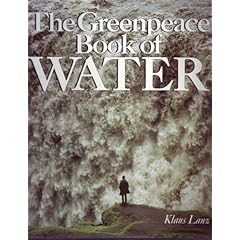
The Greenpeace Book Of Water, by Klaus Lanz (1995)
From The Latham Letter:
"...illustrative text, in-depth case studies, and spectacular photos are alternately moving in their beauty and frightening in their reality....Revel in the lush look of mist clinging to the trees in the Costa Rican rain forest, the beauty of water lilies gracing the surface of a lake in Wales, or the languid dip of a wooden oar in the reflected rays of a setting sun in China's River Li....Witness through word and picture the damage being caused by pollution, contamination, acid rain, inefficient sewage systems, phosphates from detergents and cleansers, and the simple overindulgence of people who believe their water supply is infinite. Many interesting, historic uses of water for cleansing purposes, rituals, transportation, energy and irrigation are detailed together with the various effects of each use on the world's water supply....Filled with fascinating and beautifully portrayed information."

Riverwalking: Reflections On Moving Water, by Kathleen Dean Moore (1996)
From the back cover:
"Kathleen Dean Moore is a stunning new voice among the literary naturalists. Her writing, like that of Annie Dillard or Edward Hoagland, shows us a vast, complex, partly hidden and startling world that has always been right before our eyes. In these twenty elegant and provocative essays, she invites us to travel through the West with her, and often with her family, as she rafts down rapids, hikes through dunes, camps in the desert, and walks along riverbanks. All along the way, she shares her remarkable observations about the life - both human and otherwise - that is sustained by rivers. Moore ponders love, loss, motherhood, happiness, evolution, and country music with ease and acuity.Moore is a philosopher by training and a naturalist by sentiment. The way in which she sees the world and way in which she gracefully imparts how she sees it, is a mixture of both disciplines: part keen analysis, part sumptuous embrace, of all that she sees, hears, and feels in the moving water of rivers and of memory.The result is Riverwalking, a collection that is enlightening, moving, and brilliantly conceived."

Water Music, by Majorie Ryerson (2003)
From the publisher:
"A photography book with a social conscience, Water Music affirms the intimate connection of water to the rhythms of our lives-and how it is something to be celebrated, revered, and preserved for today and for future generations. Water Music is first a tribute to the inspiration and magic of water. For photographer Marjorie Ryerson, a fascination with water grew from the challenge of capturing on film the astonishing breadth of ways in which water presents itself-the way, for instance, that Lake Superior at sunset turns from deep blue to gold, copper, blazing red, dusty pink, pewter, and, finally, shimmering black. To accompany the dazzling photographs, Ryerson recruited some of the most important names in music. These world-class artists, from twenty-two countries on five continents, and from across the musical spectrum, have contributed memoirs, stories, poetry, music, and lyrics for Water Music, reinforcing the beauty of the images and the powerful message they convey. For rhythmist Mickey Hart, the feel and sound of rain resulted in a kind of epiphany for him that has influenced his music ever since. Flutist Mary Youngblood explains that her life as a musician has been inextricably linked with having been born under the water sign of Cancer. Violinist Pamela Frank explores the many similarities between water and music, finding both essential for survival. Together, Ryerson's photos and the words and music of these renowned musicians remind us why we must heed the message in Paul Winter's introduction-in spite of our reverence and awe, we have placed this most essential element in peril. And so, we too are called upon to remind ourselves of the preciousness of water, before the damage becomes too severe to be undone. Water Music has thus become a piece of a much larger picture: the Water Music Project. Ryerson began the larger project not only to celebrate the beauty of water and its connection to music and to our lives, but also to increase awareness about water issues through concerts, lectures, events, and educational outreach. She is donating her net royalties from sales of the book to the Water Music Fund, established at her request at the United Nations Foundation. The UNF will use the fund to aid water in the natural environment and to provide clean drinking water for families around the world."

Who Owns The Water?, edited by Klaus Lanz, Lars Muller, Christian Rentsch and Rene Schwarszenbach (2006)
From the publisher:
"The shortage of fresh, clean water,” states a report by the Human Rights Commission, "is the greatest danger to which mankind has ever been exposed.” It is only thanks to water and its mysterious qualities that life on earth is possible at all. Without water there would be no food, no clothing, there would not even be the ink the Bill of Rights was written with.Who owns the Water? discusses the phenomenon of water, marvels at its uniqueness and addresses the dangers and opportunities water offers to life. The book looks at the most important questions about providing drinking water and producing food, but also deals with water as a destructive force, and investigates the chemical qualities of the molecule. Who owns the Water? points out the risks of unlimited privatization of water, and records how dependence on water is exploited. Committed picture sequences and detailed texts explain how water can belong to no one, but has to be treated responsibly and held in appropriate esteem by the whole of mankind."

The Secret Life of Water, by Masaru Emoto (2005)
From Midwest Book Review:
"A blend of science and spirituality marks Masaru Emoto's lovely The Secret Life Of Water, which links the search for happiness and serenity with the life of water on this planet. From interviews with healers and shamans whose powers have changed the shape of water itself to photos of water crystals and cycles of water and life, it's hard to easily peg The Secret Life Of Water -- but it will often find its way onto the science shelf and from there into the welcoming hands of spiritual readers as well."

Streamkeepers Field Guide: Watershed Inventory and Stream Monitoring Methods, by Tom Murdoch, Martha Cheo and Kate O’Laghlin
(no information available)

Watershed Dynamics, by William Carlsen and Nancy Trautman (2004)
**Full student edition on Google Books.
From the publisher:
"Whether you’re a stream studies novice or a veteran aquatic monitor, Watershed Dynamics gives you abundant practical resources to extend your students’ investigations into local water quality and land-use issues. This two-part set is ideal for teaching biological and ecological concepts and research techniques. It also shows how the interplay between scientific data and human judgment can shape public policy decisions on zoning, flood control, and agricultural practices."

Freshwater, by E.C. Pielou (2000)
From Library Journal:
"Our planet is composed primarily of water, much of which is the ocean and not the subject of this book. Naturalist Pielou (A Naturalist's Guide to the Arctic, LJ 11/1/94) concentrates on fresh water (usable by humans), which is a much smaller resource. Pielou describes the natural history of fresh water?where it comes from, where it goes, and how it moves under and over the earth and into the atmosphere. Even though scientists now believe that water is being added to our environment by "snowball" comets entering our atmosphere, the world's supply of fresh water is dwindling?and a shortage of usable fresh water ultimately limits population growth. Pielou's book would make an excellent textbook for any college class studying water. However, while the text is highly informative, it will not appeal to the average reader because of its technical nature. "

Topographical Description of the Western Territory of North America, by Gilbert Imlay (1797)
Illustrated with correct Maps of the Western Territory of North America; of the State of Kentucky, as divided into Counties, from actual Surveys by Elihu Barker; a Map of the Tenasee Government; and a Plan of the Rapids of the Ohio. The Third Edition With Great Additions. London: Printed For J. Debrett, Opposite Burlington House, Piccadilly.

Ohio Water Firsts, by Sherman L. Frost and Wayne S. Nicholis
(no information available)

Water Follies: Groundwater Pumping And The Fate Of America's Fresh Waters, by Robert Glennon (2004)
From Scientific America:
"In the high plains of Texas the farmers who grow cotton, alfalfa and other crops are entitled by law to as much underground water as they can reasonably use. No matter that this water comes from the Ogallala Aquifer, that vast underground reservoir whose levels have dropped precipitously since 1940. No matter that the overpumping threatens eventually to put thousands of farmers across seven states out of business. The illusion, codified in the law not just in Texas but in much of the U.S., is that groundwater is somehow boundless, or in a category apart from lakes, rivers and streams, and ought not be regulated, even for the common good. Now comes Robert Glennon to puncture this illusion, in a book as rich in detail as it is devastating in its argument. Its focus on groundwater brings overdue attention to a category that accounts for nearly a quarter of American freshwater use. Its title, Water Follies, sets the tone for tales that can be tragicomic; this is a book about water being squandered, so it is also, as the author puts it, a book about "human foibles, including greed, stubbornness, and especially, the unlimited human capacity to ignore reality." Take, for example, his story of the fast-food french fry. It used to be that potatoes were grown on unirrigated land, he writes, but Americans' love of processed foods changed that. Uneven moisture leads to small, knobby, misshapen potatoes, so most American growers, even in places such as Minnesota, routinely irrigate their lands, to produce products acceptable to the industry and customers like McDonald's. But in Minnesota the groundwater that farmers pump for potatoes turned out to be the same water that helps to sustain the Straight River, a major trout fishery. Even modest pumping for potatoes, a federal study eventually concluded, had the potential to reduce the river's flow by one third during irrigation season, with adverse impact on the brown trout. For now, the trout are not in danger, but that could change if Minnesota were to approve applications from farmers still eager to see potato planting and irrigation widen. "One long-term answer, of course," Glennon notes, with characteristic wryness, "is for us, as American consumers, to accept french fries that have slightly different colors, or minor discolorations, or even ones that are not long enough to stick out from a super-size carton." Farmers are not the only ones who get a hard time for their shortsightedness. Bottled-water purveyors, particularly Perrier, are tarred for their pursuit, in places such as Wisconsin, of cool, underground (and highly profitable) springwater in quantities so vast as to prove devastating to the ecology of nearby rivers. The gold-mining industry is called to account for "dewatering" operations in, for example, Nevada, where it makes way for its deep operations by pumping away groundwater at a stunning rate. And planners in Tampa, Fla., and San Antonio, Tex., come under fire for their cavalier reliance on perishable underground sources such as Texas's Edwards Aquifer to fuel development they are finding difficult to sustain. The cumulative picture painted by the author is a grim one. Already four states-- Florida, Nebraska, Kansas and Mississippi-- use more groundwater than surface water, and more and more are looking underground to support growing populations. Becoming equally apparent are the consequences in dry rivers, land subsidence, and aquifers drawn down far faster than they can ever be recharged. "The country cannot sustain even the current levels of groundwater use," Glennon writes, "never mind the projected increases in groundwater consumption over the next two decades." Why is it that groundwater has become subject to such abuse? One reason, of course, is that buried below the surface, it is hidden from the kind of relentless monitoring that in recent decades has helped clean up rivers such as the Erie and the Hudson. But Glennon, a professor of law at the University of Arizona, finds buried in the law some further reasons for the neglect. Even now, he says, most American laws affecting groundwater do not recognize any connection between underground and surface waters, despite abundant evidence of such links. They remain rooted in 19th-century ideas that underground flows were something so mysterious that they could not be understood, an assumption that has been translated into lax or nonexistent regulation. In most parts of the U.S., the author points out, surface water is subject to doctrines of riparian law or prior appropriation, with water rights carefully parceled out to various claimants. Groundwater, in contrast, is most often subject to the rule of capture, which, as Glennon observes, essentially means that "the biggest pump wins," notwithstanding the impact on surface water or the aquifer itself. To Glennon, the plight of the country's groundwater has come increasingly to represent what biologist Garrett Hardin called "the tragedy of the commons," a direct result of allowing citizens unlimited use of a common area. Among his recommendations for the future is an immediate halt to unregulated groundwater pumping. To some ears, especially those of high-plains Texas farmers, that is certain to sound like an unconscionable assault on property rights. But Water Follies makes the case that groundwater is something that we all should regard as very public indeed."

Discovering Unknown Landscape: A History Of America's Wetlands, by Anne Vileisis (1997)
From Publishers Weekly:
"Whether seen as "bugs and mud" or as breeding grounds for countless species of fish, birds and other organisms, wetlands have borne much of the brunt of our development as a nation, argues environmental historian and naturalist Vileisis. Here, her painstaking research into the changing ways people thought, wrote about and thereby legislated wetlands throughout the many stages of the country's development makes a compelling case for their central role in our history. Vileisis takes us through our many uses of wetlands resources, from the filling of Boston's marshes, early rice-milling dams and the travels in search of "`rare and Useful productions'" of 18th-century botanist William Bartram, to the "great Florida land giveaway" of the 1870s and the over-logging of Southern swamps. Nearly two thirds of the book deals with our own century, including the formation of the Army Corp of Engineers (and their rise to power in controlling wetlands alteration) and the enactment of the National Environmental Policy Act in the late 1960s, as well as the expanding role of concerned citizens in policy making after WWII. Along the way, Vileisis shows how America's explosive population growth and subsequent housing development decimated the habitats of waterfowl as well as those of other species. In her fine book, Vileisis provides a comprehensive account of a not so slow-motion natural disaster."

A New Discovery of A vast Country In America, by Father Lewis Henneprin (1903)
From the Wisconsin Historical Society:
"One of the most flamboyant figures in early Wisconsin history, Fr. Hennepin set sail for the west in 1679, cruising from modern Buffalo to Chicago. In February 1680 he headed south by canoe and later claimed to have gone all the way to the mouth of the Mississippi. In reality, he was captured by the Sioux somewhere north of the Illinois River, and with two companions was carried into northern Wisconsin and Minnesota. Over the next four months they ranged through much of the upper Mississippi Valley, until in August 1680, they were discovered and ransomed by the explorer Duluth."

Blue Covenant: The Global Water Crisis and the Coming Battle for the Right to Water by Maude Barlow (2008)
From From Publishers Weekly:
"Canadian antiglobalization activist Barlow (Blue Gold) calls for a blue covenant among nations to define the world's fresh water as a human right and a public trust rather than a commercial product. Barlow marshals facts and figures with admirable (if often dry) comprehensiveness, noting that as many as 36 U.S. states could reach a water crisis in five years; that once vast freshwater resources like Lake Chad and the Aral Sea are becoming briny puddles; and a handful of multinational water companies, abetted by World Bank monetary policies and United Nations political timidity, are bidding for the complete commodification of formerly public water resources. Her passionate plea for access-to-water activism is buttressed with some breakthroughs; Uruguay has enshrined public water rights in its constitution (the only nation to do so), and water warriors are fighting back in Bolivia, Argentina and Chile, where activists have forced private water companies to cede control of municipal water systems. There's a noble tilting-at-windmills quality to the author's call for private citizens and nongovernmental organizations to challenge corporate control of water delivery, agitate for equitable access to clean water and confront the reality that freshwater supplies are dwindling."

Writing On Water, edited by David Rothenberg and Martha Ulvaeus (2002)
From Publishers Weekly:
"The second volume in MIT's Terra Nova series, designed to promote an artistic, practical and political context for vital environmental topics, this collection explores the earth's ubiquitous liquid in all its permutations rain, fog, snow, mud, blood, tears, lakes, hot springs, swamps, waves, etc. From reflections on the waters of creation out of the Rig Veda, one of Hinduism's earliest writings, to Octavio Paz's magical realism, the book moves beyond mundane boundaries, offering a compendium of sacred texts, short stories, poetry, personal reflections, and scientific essays and photographs. Moving from the ancient chthonic springs of Delphi to the dark, icy Hudson River, the writings stir consciousness and conscience, while exceptional photographs complement the text. Refreshing as a cool drink from a deep well on a steamy July afternoon, the novelty, variety and quality of the readings in this collection are sure to reinvigorate."

Water: A Natural History by Alice Outwater (1997)
From Publishers Weekly:
"A generation after the Clean Water Act was passed, one third of our waters are still polluted, according to the author, and only 6% of contamination is caused by industry. Environmental engineer Outwater, who managed scum and sludge removal in the Boston Harbor cleanup, reaches back into our history to chart the changes in our waters. Once, a tenth of the total land area was beaver-built wetland; the beaver's decline caused the first major shift in the nation's water cycle. The depressions buffalo made on the ground and the holes dug by prairie dogs collected rain and runoff that seeped down to the water table; our waterways have been transformed by the loss of these keystone species. Outwater looks at grasslands and forests, artificial waterways, agriculture, aqueducts and toilet bowls, sewers and sludge (she gives a guided tour of a waste-treatment plant). She makes a strong case for restoring natural systems to public lands?repopulating beaver, bison and prairie dogs. This book is a valuable addition to environmental literature and to our understanding of water."

Gift of Rivers: True Stories of Life on the Water, edited by Pamela Michael (2000)
From google.books.com:
"Rushing, rolling, flowing — rivers provide the ultimate metaphor for movement. They carve borders, create livelihoods, provoke adventure, and offer healing. From white-knuckle rafting rides to fishing stories to eco-essays, this collection by top authors explores the historical, practical, and spiritual significance of rivers. Contributors to The Gift of Rivers include Isabel Allende, Barry Lopez, Wendell Berry, Jan Morris, William Least Heat-Moon, Richard Bangs, Simon Winchester, and many other distinguished and emerging voices — all celebrating rivers, literally and symbolically. A thoughtful introduction by former U.S. Poet Laureate Robert Hass describes the way in which rivers have fueled the imagination and spawned cultures since the beginning of time."
An Ohio Portrait, by George W. Knepper (1976)
Published for the Ohio American Revolution Bicentennial Advisory Commission by the Ohio Historical Society

Watersheds A practical Handbook on Healthy Water by Clive Dobson and Gregor Gilpin Beck (1999)
From KLIATT:
"Watersheds seeks to explain simply why putting poisons in the water is bad by showing how watersheds work, how all water systems -- streams, sewers, rivers, oceans, our own plumbing - are interconnected and interdependent. ... The author's method is excellent. ... It would make a good supplementary text for a high school biology class, but would also be nice for the ecologically conscious parent."

Atlas Of America’s Polluted Water, published by United States Environmental Protection Angency.

Labels: , , ,

Friday, August 22, 2008

The Uncanniness of Commodities: Ryan Agnew

Commodities are uncanny. So often we think of them as easily understood objects, as trivial, when in fact they are very complex and strange..."abounding in metaphysical subtleties and theological niceties." (Marx, Das Kapital)

Commodities are filled with the investments of our labor and design, becoming social things.

Marx takes this uncanny communion of objects even further with his ideas of Fetishism: “…the productions of the human brain appear as independent beings endowed with life, and entering into relation both with one another and the human race. So it is in the world of commodities with the products of men’s hands. This I call Fetishism which attaches itself to the products of labor, so soon as they are produced as commodities, and which is therefore inseparable from the production of commodities."

This framework of 'social objects' seems a worthy lens from where to view Ryan Agnew's work, Escalating Trousers, in our current exhibition, What Time is This Place.

Take the time to read (below) what Ryan has to say about this piece. Notice how easy it is to view these images as people traveling on the escalator ghost. Perhaps ghosts themselves. What happens when inanimate objects, pants, become the ghosts of people, the ghosts of soldiers and shoppers? How does this anthropomorphizing tie into the legacy of Lazarus and even the civil war? Can soldiers be commodities? If so they are humans that become objects that become uncannily human again.

What Ryan Agnew writes:
The American Civil War began ten years after Simon Lazarus opened a men's tailor shop on the dirt road that was High Street. At the end of the war, one of the first things soldiers wanted was to get out of their uniform. Each soldier went to Lazarus where he would be ushered into the basement to exchange his uniform for store clothes (leaving his uniform behind). One such customer entered the store with $400 in his uniform pocket. He received his new "duds" and left the store. A month later he returned, insisting that he had either lost his $400 or left it in his old clothes. Mr. Lazarus remembered the man. He took him down into the old clothes room and the man found everything except the trousers he had worn. Lazarus remembered then that when the man had changed clothes he threw his uniform trousers into the air, glad to be free of them. Looking up they saw the trousers caught on a nail in the ceiling. A hasty examination revealed $400 in the pocket. Time passed and the store continued as a family tradition. On Monday, August 17, 1909, the family opened a brand new six-story store on the northwest corner of High and Town Streets, just across the street from the old one. The new Lazarus featured the first department store escalator in the country. According to Charles Lazarus, however, "When the first escalator was installed, it evidently scared the daylights out of people. They had to take it out a year later." One Lazarus patron was so taken with the escalator, though, that he wrote a poem in its honor:

What's the crowd a pushin' and a shovin' over there?
Land! It's folks a ridin' up the escalator stair!
Ma's brought all the family in to take a little ride,
Cause they're simply goin' dippy
Bout that Escalator Glide!

This text is paraphrased from WOSU’s online archive of the Lazarus store,
at http://www.wosu.org/archive/lazarus/timeline.php.

Special thanks to Berry van Boekel, Jessica Brandl and Sergio Soave.

Labels: ,

Saturday, August 9, 2008

All The Time in the World / August 9th

Art events in downtown Columbus Ohio for the next few days...

Saturday the 9th
7:30-11 pm
Water on the Fire tonight at the Riverfront Amphitheater in Genoa Park. This is right behind COSI on Washington Blvd. I have never been to any of these events, but seems like a good way to chill with one of the best views of our lovely little city. Musical entertainment by Outpost.

Monday August 11
8pm
Experimental Jazzie hoopla at Cafe Le Spritz house (594 E. Rich St.). Featuring the stylings of Marina Peterson, Larry Marotta, Ryan Jewell, Dan Godston. Styrofoam on a snare drum sounds really really good, but also super intense, OK.

Tuesday August 12
11:45 am- 1:15 pm
As part of the Music in the Air concert series, the Topiary Garden / Deaf School Park hosts, Vocal Impact: Soulful harmonies with dynamic jazz arrangements. 11:45 a.m. 480 E. Town St.

Wednesday August 13th
noon-1pm
Screen Works | The Wonderful World of Dogs. A film by Mark Lewis. 52 mins.
This is happening here at the Urban Arts Space.
Bring your lunch and enjoy more Dog Days of August each Wednesday with us. See a women whose Chihuahua is carried off by a hungry pelican...and a dog with a sixth sense... The Wonderful World of Dogs explores the myths, the obsessions, and the wide variety of attitudes people harbor towards our four-legged friends by introducing a few of the barkers, bullies and roamers that make up the canine population.

Thursday August 14
5:30 - 7:30
Dialogue| Ways of Knowing Water here at the Urban Art Space.
Get With the Flow...Find Out How!
Learn from those who know! Representatives from MORPC (Mid-Ohio Regional Planning Commission), and local watershed organizations such as FLOW (Friends of the Lower Olentangy Watershed), FACT (Friends of Alum Creek & Tributaries), and other groups who work to protect our waters will be on hand to discuss creating a more river-friendly, greener Columbus. Become a river steward!

7:30 -11pm
After the talk at UAS, unwind with Cocktails at the Franklin Park Conservatory rooftop garden in the Palm House, where James Turrell has his new light installation. This is a new thing happening at the conservatory every Thursday. Full bar selection along with small plate hors d’oeuvres from Cameron Mitchell Catering. I think this place is gonna be amazing, (I like Turrell's work). I'll let you know. ( No cover – 21 and over – Free Parking)

Labels: , , , , , , , ,

Thursday, August 7, 2008

All The Time in the World / August 7th

If I had all the time in the world to spend downtown at art events in the next few days this is the stuff I would do. (Columbus, Ohio)

Tonight, Thursday August 7th.
8pm
The Shelf Gallery, at 57 E Gay Street, is hosting an acoustic music event that is going to be perfect. All these bands can be found on myspace, but trust me, I think you'll really like it.

Friday, August 8th
12 pm
VOX - Columbus Gay Men's Chorus this just seems awesome. If someone can actually make it to this, please let me know what you think.

7pm
Horton Hears a Who is showing at Genoa Park on the Riverfront behind Cosi, 303 W. Broad St.
I will be at this. The film starts at 9ish and will surely give you alot to think about.

Saturday, August 9th
Mad Theatre presents Stripped Away.
"Carol is burning the candle at both ends. By day she is a sociology professor. By night, as part of her latest sociological study, she is a waitress at The Itchy Kitty, the tri-state's #4 gentleman's club. On top of that, her relationship with her boyfriend is crumbling, her sister wants to date the club DJ, her boss wants to fire her, and she'll do about anything to keep it together." Check out the trailer. This is gonna be super zany.

Labels: , , , , , ,

Friday, August 1, 2008

Cinema is a dangerous thing.

It transports us to places and times and events. Really, it gives us the illusion we are transported. Through its magic, its sensual audio and temptuous flashing, our bodies ignite; and open is the way for cinema to take us. We leave the screening room, or theater, activated and soothed. We leave with a stain in us and on us. We go places we never go. (And it has given me really high expectations for love-type stuff!)

In our current exhibition,
What Time is This Place, Mark van Fleet explores this phenomenon with his work, "Somewhere."

"Somewhere" is a multi media installation that presents and documents a screening room that was used for a 60 hour movie marathon. In the room, there is comfortable seating, a screen, and a projector. Movies with "places" as titles were projected on the screen continuously for 3 days from July 7th through the 9th, 2008. 10 - 15 second clips of video footage were taken every 10 minutes to create a unique video montage of all of the projected films. This montage, which is both documentation of the movie marathon and a feature-length video work in its own right, is now projected onto the same screen which the original films were shown.

This work reminds me of the work of Pierre Huyghe who wrote, "Everything you look at, an object whatsoever, or image, has been thought about, selected and been subject to huge activity." Thus if cinema stains us so, where does this stain originate and where has it been? Cinema objectifies what it presents, but it seems to objectify us too. "Somewhere" collapses the event of a 3-day, 27-film movie marathon into 1 feature-length video experience, creating not only a discourse about place, document and narrative, but also about the collapse of the subject-object relationship.

-Eva Ball, exhibitions preparator and guide

Read what Mark van Fleet has written about the piece:
Screening rooms and theatres are “non places” in which extra periphery information is typically kept to a minimum in the service of transporting the viewer into the space (physical and psychological) of the film. The "Somewhere" of the video's title refers, of course, to the places as well as the times depicted in the screened films.

In cinema, Place can be a complex thing. It can be a background of stunning vistas in which most of the action takes place as in a family film like “Alaska” or an action film like “Sahara”. These are films where the location becomes almost like an extra that the characters must struggle with or against. It can be the remote or exotic locale that is reproduced on a soundstage in Hollywood ala “Macao” or “Casablanca”. A film may be an ode to the loved and familiar city as in Woody Allen’s “Manhattan”. The place may be the site of a fierce battle as in the film’s “Midway” and “Gallipoli”. Similarly, historic events in a city like Munich can inspire a film of the same title even if the events in the film do not take place very much in that southern German city. A film like “Woodstock” (the last film shown and the only documentary) captures that place in upstate New York’s iconic moment in cultural history. A film can also be absurdly named after a place for which it clearly bears no connection as in Terry Gilliam’s “Brazil”.

Time in the cinema is just as complicated. All films bear trace of the time in which they are made and they are all explorations of Time as an integral aspect of the medium. Many films take place in the “present time”, but as a film ages, we see the “present time” of those films differently. “Atlantic City” in 1981 is not the same Atlantic City of 2008. Likewise, just one interesting (and possibly depressing) thing about a film like “Nashville” from 1975 is knowing what we know about contemporary Country Music thirty years later.

Many films are “period pieces” that further problematize our experience of time. A film like the recent “Chicago” (based on a play first staged in the seventies) is supposed to take place in 1920’s Chicago during prohibition, but obviously, the film would not be the one it is even if it had been made in 1980, indebted as it is to music video influenced camera work, editing, and set design, as well fashion magazine sex appeal. Imagine how different the film would be had it been a 1950’s blockbuster! In this context, the question of “What Time is this Place?” becomes especially meaningful. “Chicago” (from 2002) feels as much like a product of its own time than the one it supposedly depicts.

I hoped that by organizing this Movie Marathon to reflect on the cinema’s relation to Place. I think that the resulting feature length montage it is a ruptured and strange meditation on that filmic idea.

The films were:

Alaska (1985) / Atlantic City (1981) / Barcelona (1994) / Brazil (1985) / Casablanca (1942) / Chicago (2002) /
Earth (1930) / Earth (1996) / Fargo (1996) / Hawaii (1966) / Istanbul (1957) / Kansas City (1996) /
Key Largo (1948) / Lake Placid (1999) / Macao (1952) / Manhatten (1979) / Montana (1950) /
Munich (2005) / Nashville (1975) / New York New York (1977) / Philadelphia (1993) / Pittsburgh (1942) / Sahara (1943) / San Francisco (1936) / Santa Fe (1951) / West of Zanzibar (1928) / Woodstock (1970)

I’d like to particularly thank Matt Bush for his devotion to this project. Matt was the only person who was present for the entire 60 hours of the marathon, and though he slept for about 5 hours (in the screening room!), he worked tirelessly and filmed a large portion of the montage. Andrew Graham helped us make it through both of the difficult late night/ early morning stretches and he also filmed significant portions of the resulting montage. Jen Burton spent a lot of time at the Marathon as well, and helped film in addition to other assistance she provided. Ryan Agnew gave great advice and also let me use his library card to secure many of the films we screened, as did Nathan Reynolds. Thanks to Berry Von Boekel and Eva Ball for all of their logistical help and to Sergio Soave, Elizabeth Gerdeman, and Kelly Stevelt-Kaser for their organizational assistance. I’d also like to thank the rest of the staff at the Urban Arts Space, the student assistants that helped put the exhibition together, and the other artists in the show for their encouragement and good humor.

-- Mark Van Fleet

Labels: ,

Thursday, July 31, 2008

All The Time in the World

If I had all the time in the world to take in the arts of Downtown Columbus Ohio, this is what I'd do for the next few days. What fun!
-Eva Ball, exhibition preparator and guide

Friday, August 1st


1
2pm: Summer Fridays at the Statehouse: Opera Columbus
Free lunchtime performing arts and music series held on the West Lawn of the Ohio Statehouse. Broad St. & High St.

1pm:
Midwestern Visions of Impressionism: 1890 - 1930
I think I am really going to this during my lunch break.
Christine Fowler Shearer, curator, will conduct a guided tour of the new exhibit at the The Riffe Gallery, located in the Vern Riffe Center for the Government and the Arts, across from the Statehouse on High Street in Downtown Columbus: 77 S. High

6pm: Happy Hour at Tip Top!!


8pm:Oliver Mtukudzi & The Black Spirits
This is super awesome afro-pop at Riverfront Amphitheater at Genoa Park, which is in front of COSI, i.e. Washington Blvd. between Town & Broad Streets.

"
Called the Grand Master of Zimbabwean traditional pop, Oliver Mtukudzi is truly one of Southern Africa's greatest musicians."

Saturday, August 2nd


7-11pm: One Man's Junk Is Another Man's Treasure: Photography by Gina Christoffersen
at ZenGenius Gallery 243 N. Fifth St.


Tuesday, August 5

11:45 am:
The Ark Band
This concert is at my current favorite park in the city: The Topiary Garden / Deaf School Park at
480 E. Town St. The Ark Band is local reggae. This event is catered, but I think you have to buy your lunch. But a good way to get out of the office.

Wednesday, August 6th

12pm – 1pm: Read Aloud Program at the Urban Arts Space
Bring your lunch, sit back, and listed to author Charlene Fix read one of Thurber's dog stories and share her own poetic reflections on dogs -- from Elkhound/Keeshond, Collie/Shepherd, Great Pyrannes, to Basset Hounds.

"Charlene Fix is a Professor of English at the Columbus College of Art Design and a member of The House of Toast Poets. She has received poetry fellowships from the Ohio Arts Council and the Greater Columbus Arts Council, and has published poems in various literary magazines, among them The Journal, The Manhattan Review, The Cincinnati Review, Alimentum, and Poetry."

6pm: Brock Clarke at the Thurber House

Brock Clarke will read from his latest novel for the final installment of Thurber House's 2008 summer Literary Picnics Wednesday.

Labels: , , , ,

News: Exhibit taps into importance of water in central Ohio

The Columbus Dispatch wrote:

Hydro dynamic
: Exhibit taps into importance of water in central Ohio
Sunday, July 27, 2008 3:21 AM


In the mid-1800s, water was central to the lives of Ohioans: The state bustled with canal travel, every city of note was situated next to Lake Erie or a river, and many a factory was fueled by water power.

Today, it seems, we central Ohioans barely notice our water.

We take for granted the Downtown riverfront. We often mistake the Olentangy for the Scioto. We rarely travel on either river.

"Ways of Knowing Water," an exhibit continuing Downtown through Aug. 30 in the Ohio State University Urban Arts Space, seeks to remind us how crucial water is to life and how splendid the waterways of central Ohio can be to the attentive eye... Read More.


( Photo: Visitors to the "Ways of Knowing Water" exhibit view a video of the Olentangy River by Elizabeth Gerdeman and George C. Anderson. JEFF HINCKLEY | Dispatch photos)

"Back in 1908, a third of the population died of water-borne diseases. And in the middle of a typhoid breakout, we decided to do something about that, plain and simple." Conrade Hinds
Columbus Division of Water

Labels: , ,

News: Celebrate our City's Water

The Columbus Alive Wrote:

July 24, 2008

Go with the flow

By Bryan Bullock

"Olentangy River Riffles South of Bethel Road" by George C. Anderson

The lush foliage, reflective blue ripples of water and rutted bark in George C. Anderson's river pictures have a beckoning, dreamlike quality. Generally a purveyor of commercial work, the photographer seems to be advertising the allure of some placid vacation spot, far from the city, with the images he shot while spending his free time canoeing and fishing. But most of his works, included in the Ways of Knowing Water exhibit on view through August at OSU Urban Arts Space, were taken along the Olentangy River, inside of I-270...Read More

Labels: , ,